
You started your business for freedom. So why does it feel like you can’t step away without everything stalling?
If that sounds familiar, you’re not failing. You’ve built something that works, but it may be working through you rather than without you. That’s the difference between owning a job and owning a business.
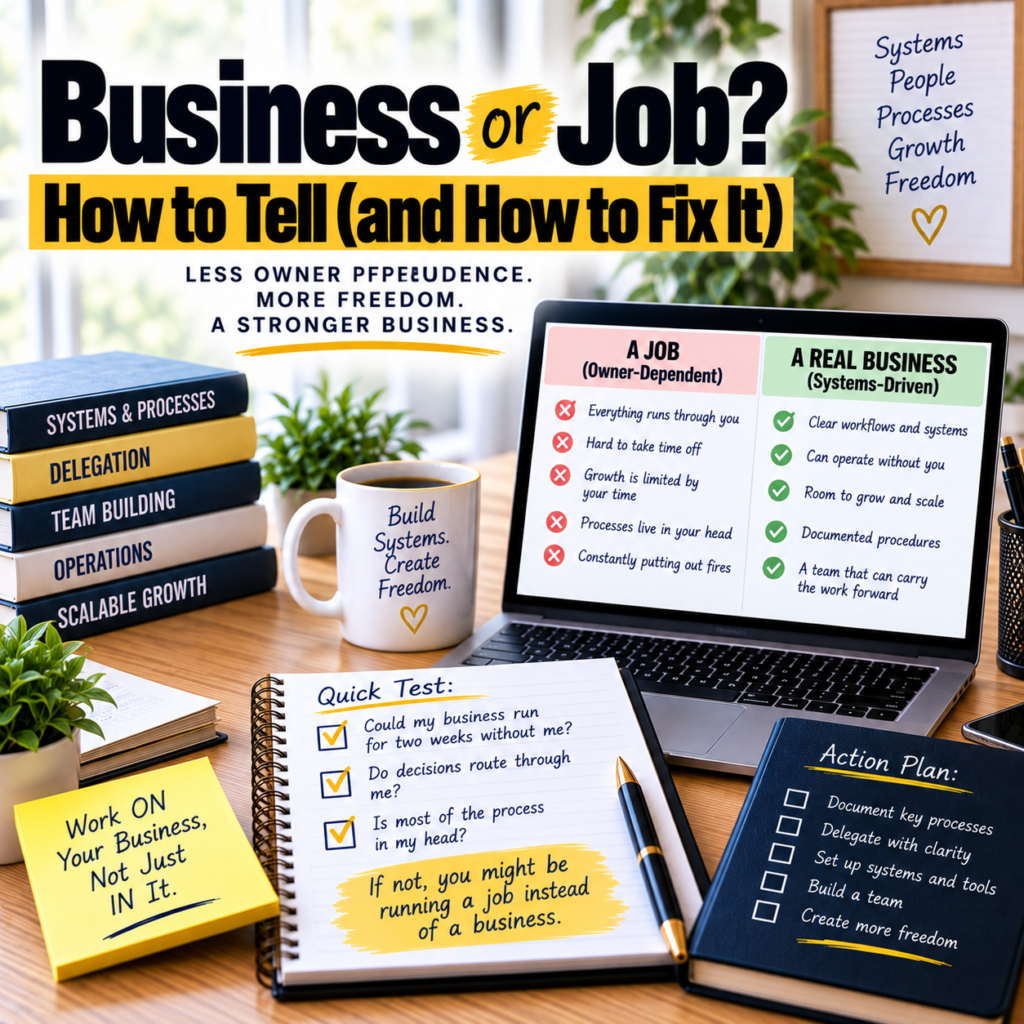
The Quick Test
Ask yourself:
- If I took two weeks off, would revenue and client service continue smoothly?
- Do decisions, approvals, and answers all route through me?
- Is most of the process stored in my head instead of on paper?
If you answered “no” or “yes” in the wrong places, your business is likely owner-dependent.
The Hidden Ceiling in Owner-Dependent Businesses
When one person holds everything together, capacity is fixed. There are only so many hours in a day, and every new client or project lands on the same shoulders.
The result is predictable:
- Burnout, because you’re always on
- Inconsistent quality, because you’re stretched thin
- Stalled growth, even when demand and revenue are strong
A profitable business can still be a trap if the only way to grow it is to work more hours.
What a Real Business Looks Like
A scalable business runs on systems, not heroics. Work moves forward without constant oversight because the structure is already in place:
- Clear workflows so everyone knows the next step
- Defined roles so nothing falls between the cracks
- Documented procedures so quality doesn’t depend on memory
- Tools and automation that remove single points of failure
Delegation Is More Than Handing Off Tasks
Many owners try delegation and give up because it didn’t stick. Usually the issue isn’t the person; it’s that only the task was handed off, not the responsibility.
Effective delegation includes:
- The outcome you expect, not just the steps
- The standard of quality (examples help)
- The authority to decide within clear limits
- A check-in rhythm so you’re informed without hovering
Done well, delegation frees you to focus on strategy, growth, and decision-making instead of daily execution.
Systems Create Freedom
A system turns repeated actions into predictable results. Think customer onboarding, billing, scheduling, fulfillment, and marketing. When these run on a defined process, there’s less guesswork, fewer mistakes, and much less mental load.
You don’t need to systematize everything at once. Start with the task you repeat most often or the one that causes the most stress, and build from there.
Conclusion
A business that can’t operate without its owner has a growth limit built in. Sustainable growth comes from creating processes, building systems, and developing a team that can carry the work forward.
The difference between a job and a business isn’t income. It’s how well the business functions when you’re not the one holding it up.
Pro Tip: This week, track every task you do for five days and mark each one as either only I can do this or someone else could do this with instructions. Pick the one recurring “someone else” task that costs you the most time, record yourself doing it once (a screen recording or phone video works), and turn that into your first documented process. That single recording is the fastest path to your first successful handoff.
Want to learn more?
Explore the Business Owner Hub
Visit the Business Owner Hub for a guided experience through BizTax Playbook’s free educational resources, calculators, planning strategies, and tools to help you navigate your business journey with confidence.
Join Our Network
Join Our Network to receive educational tips, workflow reminders, tax law updates, deadlines, calculators, and other resources designed to help you make more informed business and tax decisions throughout the year.