
If you’ve ever looked at your tax bill and thought, “There has to be a better way,” you’re not alone. Most business owners are great at running their business and have never had anyone explain how the tax side works.
Here’s the good news: the answer usually isn’t hunting for more write-offs. Lower taxes more often come from a few smart, legal decisions made at the right time. Here are five to start with.
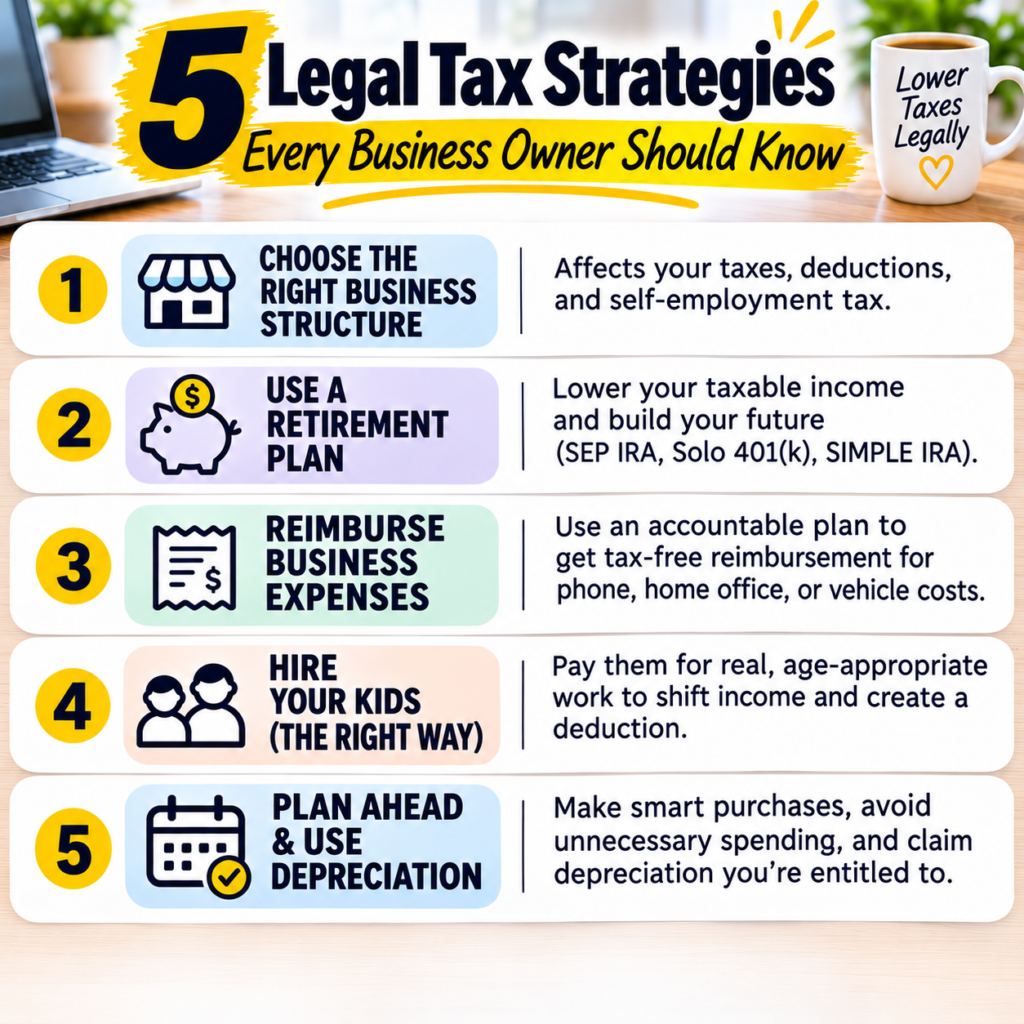
1. Choose the Right Business Structure
Your entity type affects how your income is taxed, how much self-employment tax you pay, and which deductions and benefits are available to you.
A sole proprietor, an LLC taxed as a partnership, an S corporation, and a C corporation are each taxed differently. As profits grow, many owners look at S corporation status, which can change how income is split between salary and distributions. It also comes with requirements, including paying yourself a reasonable salary, running payroll, and filing additional returns.
Practical takeaway: Don’t pick a structure because a friend did. Run the numbers with a tax professional at least once a year, especially when your income changes.
2. Take Advantage of Retirement Plans
A retirement plan does two things at once: it builds your future and can lower your taxable income today.
Business owners often have options employees don’t, such as a SEP IRA, a Solo 401(k), or a SIMPLE IRA. Each has different contribution rules, deadlines, and paperwork. Contribution limits are adjusted regularly, so check the current figures before you decide how much to put in.
Practical takeaway: Some plans must be set up by a certain date to count for the year, and the deadlines differ by plan type. Ask now rather than in April.
3. Reimburse Business Expenses Properly
If you use your phone, home office, or vehicle for business, how you get reimbursed matters. For owner-employees, unreimbursed work expenses are generally not deductible. A written accountable plan can fix that by letting the business reimburse you for legitimate expenses in a tax-friendly way.
Accountable plans have rules: the expense must be business-related, you must substantiate it, and any excess must be returned within a reasonable time. Done right, it’s a clean, defensible process. Done casually, it’s an audit risk.
Many owners overlook this one.
Read more in Accountable Plans: The Tax Strategy Many Business Owners Overlook.
4. Consider Hiring Your Kids (the Right Way)
If your children do real work for your business, paying them reasonable wages can be a legitimate way to shift income and teach them about work. The key words are real and reasonable. The work must be genuine, age-appropriate, documented, and paid at a rate you’d pay any other worker. Depending on your business structure and your child’s age, there may also be payroll tax advantages.
This only works when it’s done properly, so keep timesheets, run payroll correctly, and pay them like employees. Get the full breakdown in Hiring Kids: A Tax Strategy Many Business Owners Overlook.
5. Plan Ahead, Spend Wisely, and Don’t Ignore Depreciation
Good tax planning happens before the year ends, not after. That includes a few things people often get backwards.
Spending too little can cost you. Avoiding purchases your business truly needs can mean higher taxable income and missed growth. See Too Little Spending Can Cost More Than You Think.
Spending too much isn’t a strategy either. Buying something just for the deduction still means spending a dollar to save a fraction of it. Learn why in Why Unnecessary Spending Is Not a Tax Strategy.
Missed depreciation can often be corrected. If you didn’t claim depreciation you were entitled to, don’t panic. You may not need to amend your return. Read Did You Miss Depreciation? You May Not Need to Amend Your Return.
Practical takeaway: Schedule a mid-year and a year-end tax check-in. Even one 30-minute conversation can change your outcome.
Conclusion
The best strategy depends on your business, your income, and your long-term goals. What saves one owner thousands might do nothing for another. Start with the one or two ideas above that fit your situation, and build from there.
Pro Tip: Before your next meeting with your tax pro, write down three things: your expected income this year, any big purchases or hires you’re considering, and any retirement contributions you want to make. Showing up with these turns a basic “here’s your return” meeting into a proactive planning session, which is where the savings tend to happen.
Want to learn more?
Explore the Business Owner Hub
Visit the Business Owner Hub for a guided experience through BizTax Playbook’s free educational resources, calculators, planning strategies, and tools to help you navigate your business journey with confidence.
Join Our Network
Join Our Network to receive educational tips, workflow reminders, tax law updates, deadlines, calculators, and other resources designed to help you make more informed business and tax decisions throughout the year.