
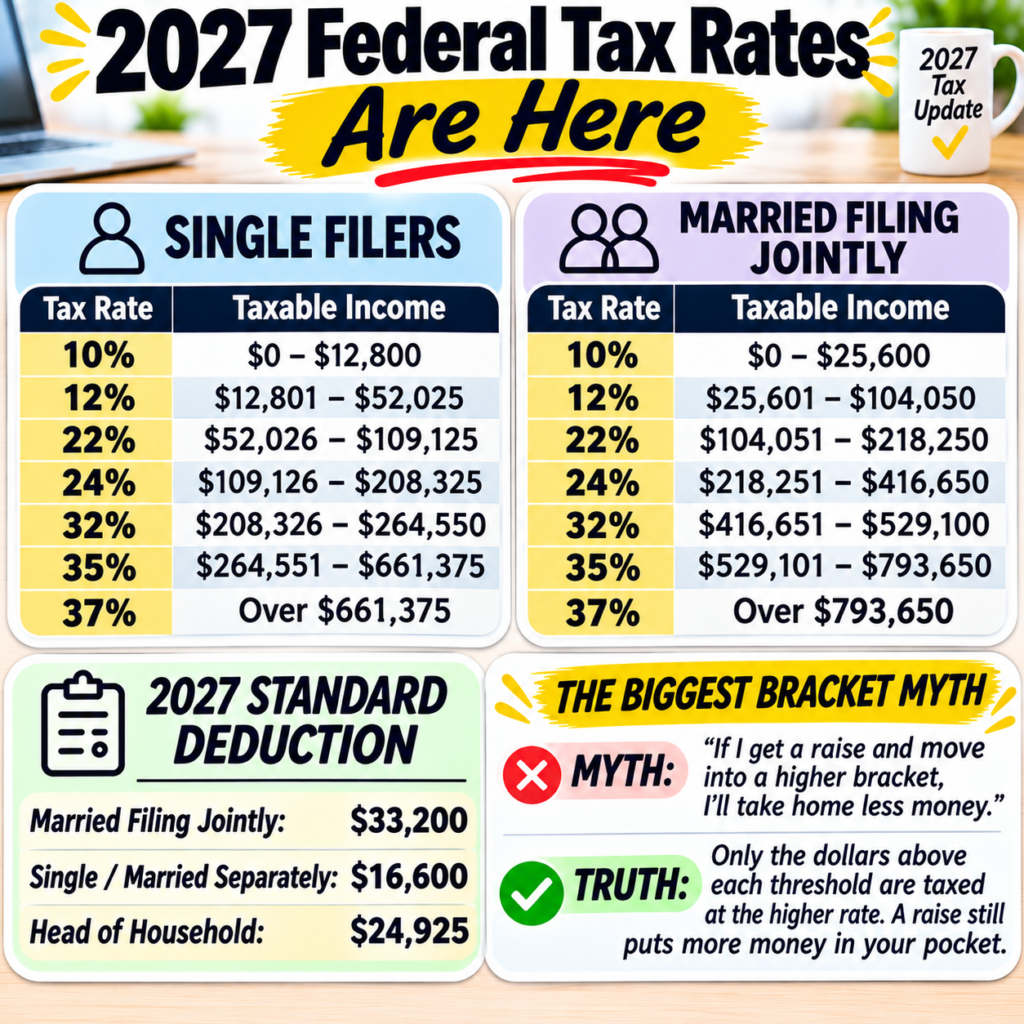
The IRS just released the updated federal income tax brackets and standard deduction amounts for 2027. If you’ve ever stared at a tax chart and felt your eyes glaze over, this one is short, clear, and made to save.
One note first: these numbers apply to income you earn in 2027, reported on the return you file in 2028. They don’t change anything on the return you’re filing this coming spring.
2027 Tax Brackets: Single Filers
The 10% rate applies to taxable income up to $12,800, and the top rate stays at 37% for income over $661,375. Here’s the full breakdown:
- 10%: $0 – $12,800
- 12%: $12,801 – $52,025
- 22%: $52,026 – $109,125
- 24%: $109,126 – $208,325
- 32%: $208,326 – $264,550
- 35%: $264,551 – $661,375
- 37%: Over $661,375
2027 Tax Brackets: Married Filing Jointly
- 10%: $0 – $25,600
- 12%: $25,601 – $104,050
- 22%: $104,051 – $218,250
- 24%: $218,251 – $416,650
- 32%: $416,651 – $529,100
- 35%: $529,101 – $793,650
- 37%: Over $793,650
The rates themselves haven’t changed. The income thresholds moved up to account for inflation, so more of your income can stay in the lower brackets.
The New Standard Deduction
For 2027, the standard deduction is $33,200 for married couples filing jointly, up $1,000 from 2026. It’s $16,600 for single filers and married individuals filing separately, and $24,925 for heads of household.
The brackets apply to your taxable income, which is what’s left after you subtract the standard deduction (or your itemized deductions). So a single filer earning $76,600 would have $60,000 of taxable income if they take the standard deduction.
The Biggest Myth About Tax Brackets
Myth: “If I get a raise and move into a higher bracket, I’ll take home less money.”
Truth: It doesn’t work that way. Only the dollars above each threshold are taxed at the higher rate. Your earlier dollars stay taxed at the lower rates.
Example: A single filer with $60,000 in taxable income in 2027 would pay:
- 10% on the first $12,800 = $1,280
- 12% on the next $39,225 (up to $52,025) = $4,707
- 22% on only the last $7,975 = $1,754.50
That’s about $7,741.50 in total federal income tax, or roughly 12.9% of taxable income, not 22%. Landing in the 22% bracket doesn’t mean all your income is taxed at 22%.
So a raise never leaves you with less money because of brackets. Only the extra dollars get taxed at the higher rate, and you keep the rest.
Quick Recap
- Rates are unchanged, but bracket thresholds are higher for 2027.
- The standard deduction is $16,600 (Single) and $33,200 (Married Filing Jointly).
- Brackets are marginal. Only income above each threshold is taxed at the higher rate.
Pro tip: Planning is easier when the numbers are in one place. Bookmark the 2027 Federal Tax Rates resource so you can come back to it when you’re estimating taxes, setting a budget, or deciding how much to set aside from each paycheck.
Want to learn more?
Explore the Business Owner Hub
Visit the Business Owner Hub for a guided experience through BizTax Playbook’s free educational resources, calculators, planning strategies, and tools to help you navigate your business journey with confidence.
Join Our Network
Join Our Network to receive educational tips, workflow reminders, tax law updates, deadlines, calculators, and other resources designed to help you make more informed business and tax decisions throughout the year.