
You chose your business structure, filed the paperwork, and moved on. Most business owners do. But that one decision, made once, often quickly, quietly, shapes how much you pay in taxes every single year.
As your revenue grows, the gap between a structure that fits and one that doesn’t gets wider. And wider gaps mean more money left on the table.
Read Also: Are You Overpaying in Taxes Right Now?
It’s Not Just a Legal Checkbox
Choosing a business structure feels like paperwork. It’s not. It’s a tax decision with real dollar consequences.
Your structure determines:
- How your income is taxed
- How much of your earnings are subject to self-employment tax
- Which deductions you can claim
- Whether you can retain earnings inside the business
- How you report income throughout the year
Two businesses with the same revenue can end up with very different tax bills, simply because of how they’re structured.
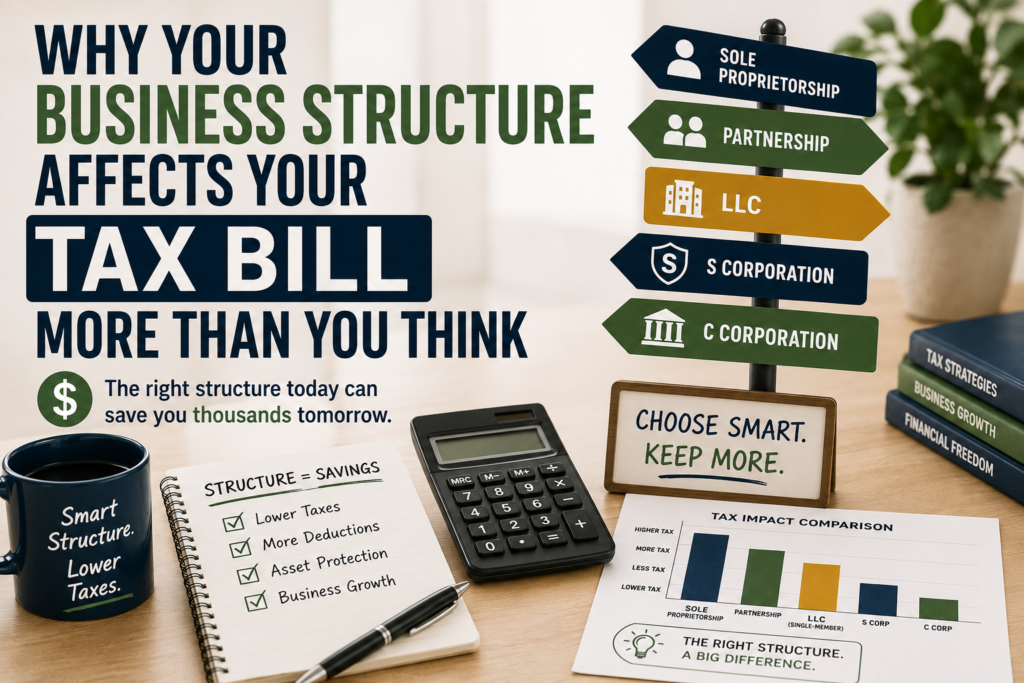
What Each Structure Actually Means for Your Taxes
Here’s an easy-to-understand breakdown of the most common structures:
Sole Proprietorship
- All profit is taxed as personal income and subject to self-employment tax (15.3% on the first $160K).
- Simple to set up, but it can become expensive as income grows.
Partnership
- Income passes through to partners and is reported on personal returns.
- Both income and SE taxes apply, similar exposure as sole proprietors, split between partners.
LLC (Single-Member)
- Taxed like a sole proprietorship by default.
- Offers liability protection, but not automatic tax savings.
- You can elect to be taxed as an S-Corp to save on taxes, potentially.
Read Also: Multi-Member LLCs: Here’s What You Must Get Right
S Corporation
- Let’s you split income between salary and distributions.
- You only pay payroll taxes on your salary, not on distributions.
- This can meaningfully reduce SE tax as profits grow.
Read Also: 4 Expert Tips to Get the Most Out of Your S-Corp
C Corporation
- Pays corporate tax at a flat rate (currently 21%).
- No self-employment tax, but profits distributed as dividends may be taxed again at the personal level.
- Better for businesses reinvesting profits or raising capital.
The Structure You Started With May Be Costing You Now
Here’s what happens to a lot of business owners: they start as a sole proprietor or single-member LLC because it’s fast and easy. Then revenue grows. Then the self-employment taxes grow with it.
At around $40,000-$50,000 in net profit, many business owners start to feel the pinch. By $100,000+, the difference between a sole proprietorship and an S-Corp election can mean thousands of dollars per year.
This isn’t about doing anything complicated. It’s about asking the right question at the right time: Is my structure still working for me, or am I just used to it?
When to Revisit Your Structure
You don’t need to review this every year. But there are clear moments when it’s worth a closer look:
- Your net profit has grown significantly since you started
- You’re paying a lot in self-employment taxes and wondering if there’s a better way
- You’ve brought on a partner or hired employees
- You’re planning to reinvest heavily in the business
- You’re looking to raise outside funding
A periodic review isn’t about restructuring every time you hit a new milestone. It’s about making sure the foundation still makes sense for where the business is headed.
Final Thoughts: Periodically Review Your Tax Structure
Business structure isn’t a set-it-and-forget-it decision. It’s a financial lever, one that can reduce unnecessary taxes, improve cash flow, and give you more flexibility as your business grows.
The best structure for you depends on your income level, your goals, and how you want to pay yourself. What worked at $30,000 in profit may not be the smartest move at $150,000.
Take the time to look at this now. Your future tax bill will thank you.
Pro Tip: Not sure which structure makes the most sense for your income level? Use our Self-Employed vs S-Corp Calculator to see the potential tax difference side by side.
Want to learn more?
Explore the Business Owner Hub
Visit the Business Owner Hub for a guided experience through BizTax Playbook’s free educational resources, calculators, planning strategies, and tools to help you navigate your business journey with confidence.
Join Our Network
Join Our Network to receive educational tips, workflow reminders, tax law updates, deadlines, calculators, and other resources designed to help you make more informed business and tax decisions throughout the year.