
If you’ve ever been blindsided by a tax bill that felt way bigger than it should have been, you’re not alone, and you’re not doing anything wrong. Most people simply were never taught how self-employment taxes actually work.
Here’s the part that catches almost everyone off guard: unlike a W-2 job where taxes come out of every paycheck automatically, self-employed income doesn’t have anyone doing that for you. That job falls to you, four times a year, in the form of estimated tax payments. Skip it, and even a fully paid tax bill in April won’t save you from penalties.
The good news? Once you understand how the system works, it stops being scary and starts being just another part of running your business.
Read Also: Quarterly Tax Planning: How Estimated Tax Projections Make April Easier
What Are Estimated Taxes, Really?
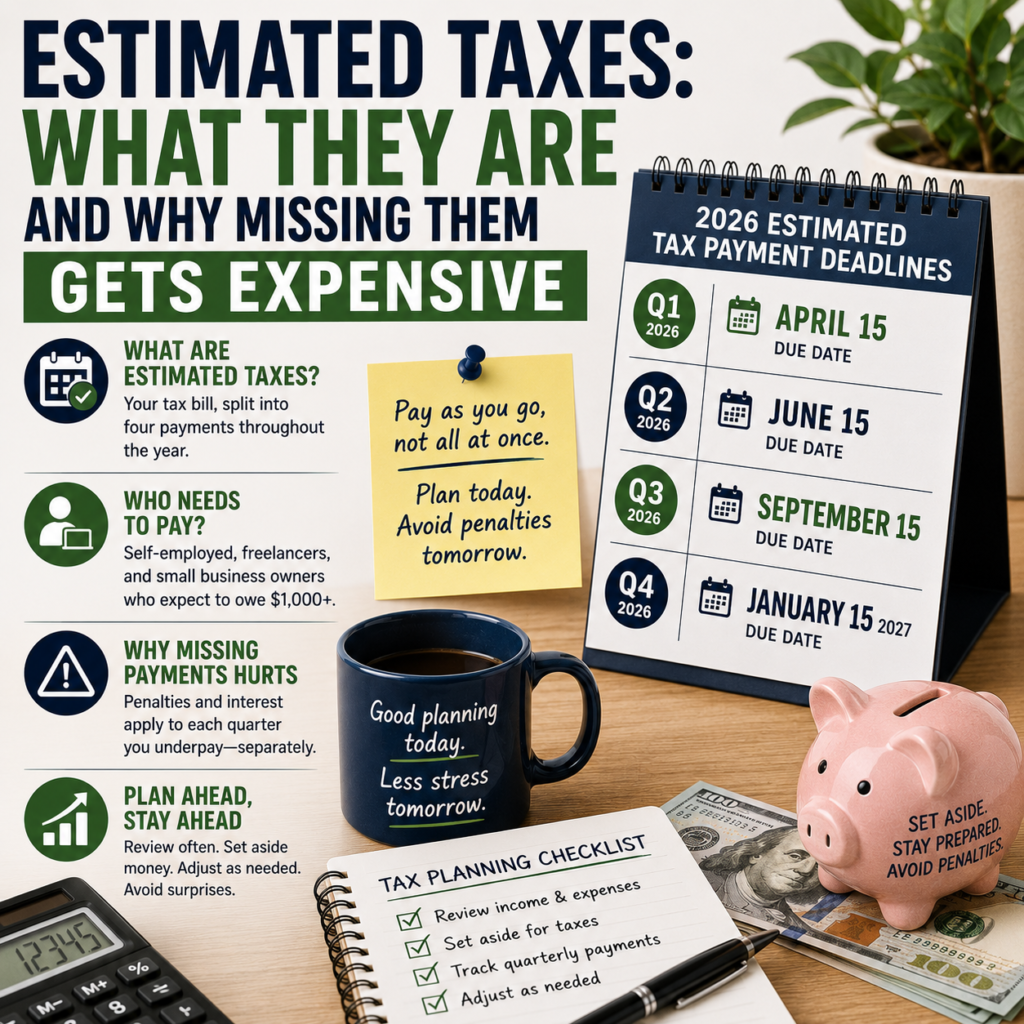
Estimated taxes are simply your tax bill broken into four payments instead of one. Rather than handing the IRS a lump sum in April for income you earned all year, you pay as you go, based on what you expect to earn.
If you’re self-employed, freelance, or run a small business, this applies to you the moment you expect to owe $1,000 or more for the year after subtracting any withholding and credits. That threshold is lower than most people assume, which is exactly why so many new freelancers get caught by surprise in their first year.
The Payment Deadlines
Estimated payments follow a set schedule each year, and it’s a little uneven; the gap between payments isn’t always three full months, which trips people up:
- Q1: due April 15
- Q2: due June 15
- Q3: due September 15
- Q4: due January 15
Notice that Q2 covers only two months of income (April and May) but is still due exactly two months after Q1. It’s a schedule that rewards planning rather than reacting after the fact.
Why Missing a Payment Costs More Than You’d Think
Here’s the misconception that trips up even careful business owners: paying your full balance in April does not erase the cost of missing a payment earlier in the year.
The IRS looks at each quarter separately. If you underpaid in Q1 but overpaid in Q3, that doesn’t average out; you still owe a penalty on the Q1 shortfall, calculated from the date it was due. Interest accrues the entire time, meaning a payment you “catch up on” later has already been quietly costing you money.
In practical terms, this means the moment you fall behind is the moment to make a payment, not to wait for the next quarter, and definitely not to wait for filing season.
Planning So You’re Never Caught Off Guard
The businesses that handle estimated taxes with the least stress all do one thing in common: they check in on their numbers regularly instead of guessing once a year.
- Review income and expenses monthly, not just at tax time
- Set aside a percentage of every payment you receive, before you spend it
- Re-estimate your quarterly payment if a big project or slow month changes your income
- Keep a running total so nothing arrives as a surprise in January
None of this requires a finance degree. It requires a habit, and a little bit of structure around money that’s easy to build once you know what to look for.
Turning Estimated Taxes Into a Predictable System
Estimated taxes aren’t just a compliance box to check. Handled well, they’re one of the simplest financial planning tools available to a self-employed person: a built-in reason to review your numbers four times a year instead of once.
When you treat estimated payments as a regular, expected part of doing business, rather than a bill that shows up out of nowhere, they stop being stressful. They become one more sign that your business is being run with intention.
Pro Tip: Our Estimated Tax Safe Harbor Calculator is a great place to start. For a more accurate estimate based on your current year’s income, consider working with a tax advisor on real-time tax projections.
Want to learn more?
Explore the Business Owner Hub
Visit the Business Owner Hub for a guided experience through BizTax Playbook’s free educational resources, calculators, planning strategies, and tools to help you navigate your business journey with confidence.
Join Our Network
Join Our Network to receive educational tips, workflow reminders, tax law updates, deadlines, calculators, and other resources designed to help you make more informed business and tax decisions throughout the year.