
If you’ve been Googling “should I become an S-Corp” at 11 pm, you’re not alone. It’s one of the most common, and most confusing, questions small business owners face once income starts to grow. The tax savings sound great. The rules sound complicated. And nobody wants to make an expensive mistake with the IRS.
Here’s the good news: this decision isn’t as complicated as it feels once you break it into two simple questions: how much could you save, and can you handle what it takes to maintain it? Let’s walk through both.
Read Also: 4 Expert Tips to Get The Most Out of Your S-Corp
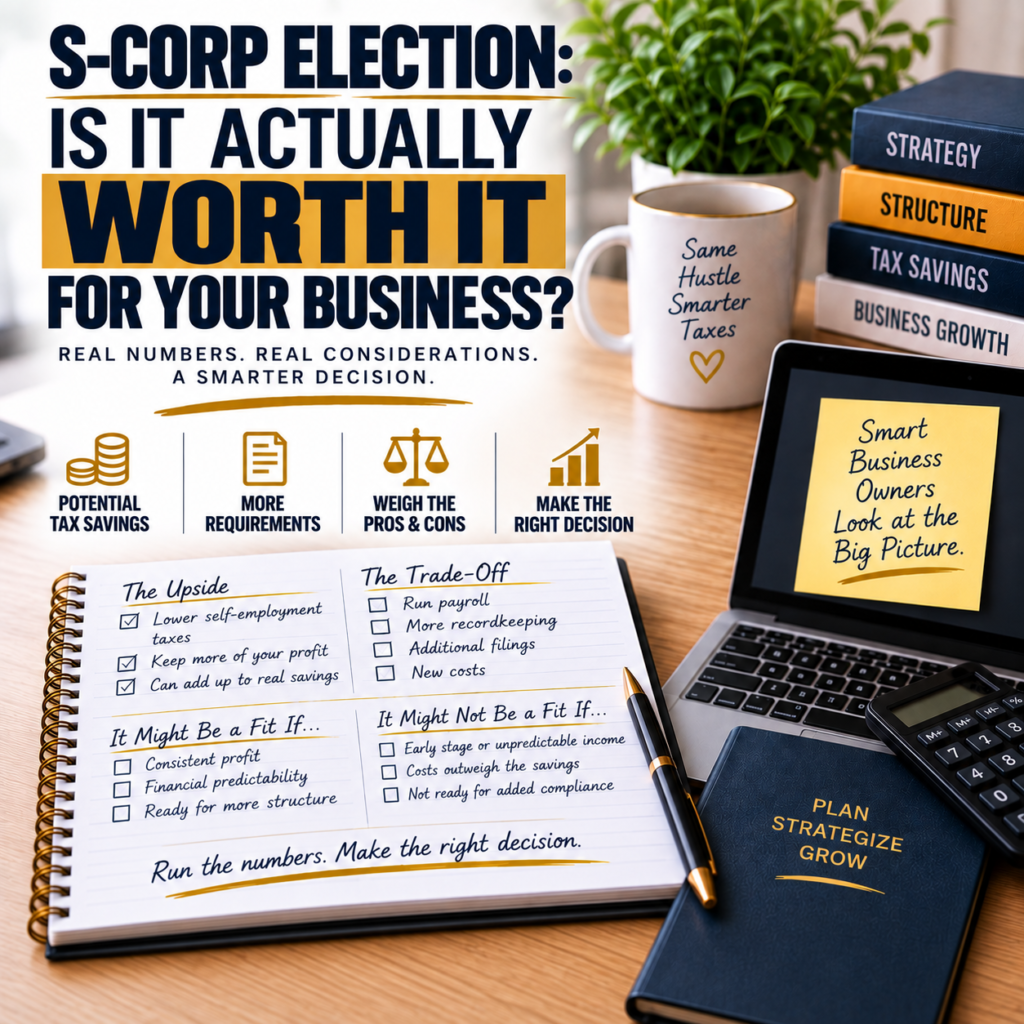
The Upside: Lower Self-Employment Taxes
Right now, if you’re a sole proprietor or single-member LLC, every dollar of profit gets hit with self-employment tax (that’s Social Security and Medicare, currently 15.3%) on top of income tax.
Electing S-Corp status changes that math. You pay yourself a “reasonable salary” through payroll, and you can take the rest of the profit as a distribution, which isn’t subject to self-employment tax. For business owners with solid, consistent profit, that difference can add up to real money every year.
The catch: this only pays off once your profit is high enough that the tax savings outweigh the new costs you’re about to take on below. No magic number applies to everyone, but this strategy generally starts making sense once net profit is consistently well above what you’d pay yourself as a fair salary.
The Trade-Off: More Structure, More Cost
Nothing worthwhile is free, and S-Corp status is no exception. Once you elect it, you’re taking on real responsibilities:
- Running payroll: Even if it’s just you, you now have to pay yourself officially, with the withholding and filings that come with it
- Tighter recordkeeping: The IRS expects clean books that clearly separate salary from distributions
- Additional filings: A separate business tax return and stricter compliance expectations
- New costs: Payroll software or a service, plus likely more from your accountant
None of this is difficult, but it is ongoing. If you’re not ready to stay on top of it, the administrative load can quietly eat into the savings you were chasing in the first place.
When It Actually Makes Sense
S-Corp status tends to be a good fit when:
- Your business has consistent, sustainable profit, not just one good month
- You’re past the early “figuring it out” stage and have some financial predictability
- You’re comfortable adding payroll and a bit more structure to your operations
It tends to be a poor fit when:
- You’re still in the early stages, and profit is unpredictable
- The extra costs would eat up most (or all) of the tax savings
- You don’t have the bandwidth to manage the added compliance
The Bottom Line
There’s no universal right answer here, only the right answer for your numbers. The decision really comes down to one honest question: does the tax savings outweigh the added cost, complexity, and time?
If you’re on the fence, don’t guess. Run your actual numbers, talk to a tax professional, and make the call with real data instead of a general rule of thumb.
Pro Tip: Not sure where you land? Plug your numbers into our free Self-Employed vs. S-Corp Calculator to see your potential tax savings in minutes, no guesswork required.
Want to learn more?
Explore the Business Owner Hub
Visit the Business Owner Hub for a guided experience through BizTax Playbook’s free educational resources, calculators, planning strategies, and tools to help you navigate your business journey with confidence.
Join Our Network
Join Our Network to receive educational tips, workflow reminders, tax law updates, deadlines, calculators, and other resources designed to help you make more informed business and tax decisions throughout the year.