
Every December, the same advice makes the rounds: “Go buy something before year-end so you don’t owe so much.” It feels productive. You’re taking action, you’re beating the tax man, and you get a shiny new thing out of it.
But that logic has a hole in it, and it’s costing business owners real money.
What a Deduction Actually Does
A deduction lowers the income you’re taxed on. It is not a rebate, and it is not free money.
Here’s the math most people skip:
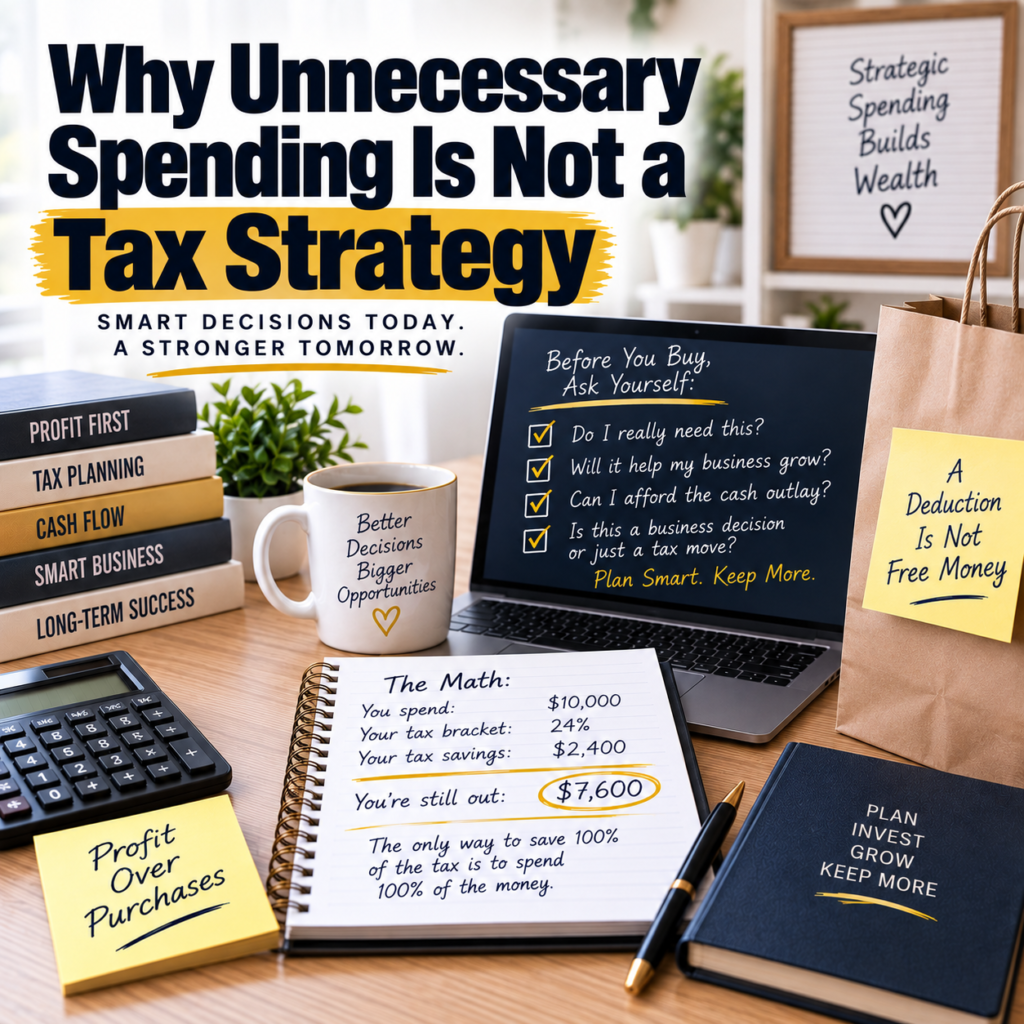
You spend $10,000 on something you don’t really need. You’re in the 24% bracket. Your tax bill drops by $2,400.
You are still out $7,600.
That’s the whole story. You traded $7,600 in cash for an item you didn’t need, and you did it on purpose. If that item had been something your business genuinely required, the trade would have been excellent. If it wasn’t, you just paid $7,600 for a smaller tax bill.
The only way to save 100% of the tax is to spend 100% of the money.
Read Also: Common Tax Write-Offs Business Owners Forget Every Year
The Part That Hurts Later
Cash is the thing that keeps a business alive. It covers payroll during a slow quarter, it funds the hire you’ve been putting off, it pays down the loan eating your margins, and it lets you say yes when an opportunity shows up in March.
Money spent on a year-end deduction is money that can’t do any of those things. The deduction shows up once, on one tax return. The missing cash shows up every month after that.
This is also why the “buy the big equipment now” advice can backfire. Section 179 and bonus depreciation are genuinely powerful tools; but they accelerate a deduction you were going to get eventually. You’re moving a benefit forward, not creating one out of nothing. If the purchase wasn’t already on your roadmap, you’ve spent real dollars to reshuffle a timeline.
A Simple Filter for Any Purchase
Before you buy anything for tax reasons, ask these in order:
- Would I buy this if there were no deduction at all? If yes, buy it and enjoy the tax benefit. If no, stop here.
- Does this make the business faster, better, or more profitable? Equipment that removes a bottleneck, software that saves ten hours a month, training that lets you raise your rates, these pay twice.
- Can I afford the cash, not just the net cost? The $10,000 leaves your account now. The $2,400 comes back at filing.
- Is the timing driven by the business or by the calendar? December urgency is a red flag, not a strategy.
If a purchase clears all four, it isn’t a tax move. It’s a good business decision that happens to be deductible, which is exactly what you want.
Where Real Tax Savings Live
The strategies that move the needle usually aren’t purchases at all:
- Entity structure. How your business is organized can affect self-employment tax significantly.
- Retirement contributions. A SEP-IRA or solo 401(k) deduction keeps the money, it moves from one of your accounts to another instead of leaving entirely.
- Timing income and expenses across tax years when your bracket is shifting.
- Deductions you’ve already earned but aren’t claiming. Home office, mileage, health insurance premiums, business use of your phone. This is the most common place money is quietly left behind.
- Quarterly estimated payments that stop the April surprise from happening in the first place.
Notice what these have in common: none of them require you to spend money on something you don’t want.
The Actual Goal
Paying less tax is not the objective. Keeping more money is.
Those two sound identical, and they aren’t. A business that earns $300,000 and pays $70,000 in tax is in a better position than one that earns $150,000 and pays $25,000, even though the second one “won” on taxes. Profit is the scoreboard. Taxes are a line item on it.
Plan the business first. Then plan the taxes around it.
Pro Tip: Before the year closes, sit down with your accountant before you spend, not after. A thirty-minute conversation in November about which deductions you’ve already earned is worth more than a panicked purchase on December 30th, and it usually turns up savings that don’t cost you a dime.
Want to learn more?
Explore the Business Owner Hub
Visit the Business Owner Hub for a guided experience through BizTax Playbook’s free educational resources, calculators, planning strategies, and tools to help you navigate your business journey with confidence.
Join Our Network
Join Our Network to receive educational tips, workflow reminders, tax law updates, deadlines, calculators, and other resources designed to help you make more informed business and tax decisions throughout the year.