
You sat down in January, did some math, and set your quarterly payment. Then March brought a big new client, summer got busy, and that number you picked back in winter is still the number you’re sending the IRS.
That gap is where underpayment penalties live. Most people don’t realize it opened until their return is already being prepared.
Read Also: Tired of Finding Out That You Owe Taxes in April?
The Misconception That Costs the Most
Many business owners assume that as long as they pay the balance in full by the filing deadline, everything is fine. It isn’t. The tax system is pay-as-you-go: the IRS expects taxes to be paid as income is earned, not after the year closes.
Miss a quarterly installment or underpay one, and interest starts accruing from that quarter’s due date; not from April. For individuals, the IRS charges 7% annually on underpayments, compounded daily, for the quarter beginning October 1, 2026, and that rate is recalculated every quarter, so it can move up or down. Daily compounding is why the final bill feels like it came out of nowhere. It didn’t arrive all at once. It grew.
The Safe Harbor Rule (Your Actual Target)
Here’s the part that turns anxiety into a number. You generally avoid an underpayment penalty if your payments and withholding for the year total at least:
- 90% of what you’ll owe this year, or
- 100% of what you owed last year; bumped to 110% if your prior-year AGI was over $150,000 ($75,000 if married filing separately)
Whichever is smaller. That second option is the quiet hero for anyone with unpredictable income: if last year’s total tax was $18,000 and your AGI was under $150,000, paying $18,000 across four installments protects you from penalties even if this year turns out to be your best year ever. You’ll still owe the difference at filing, but you won’t owe penalties on top of it.
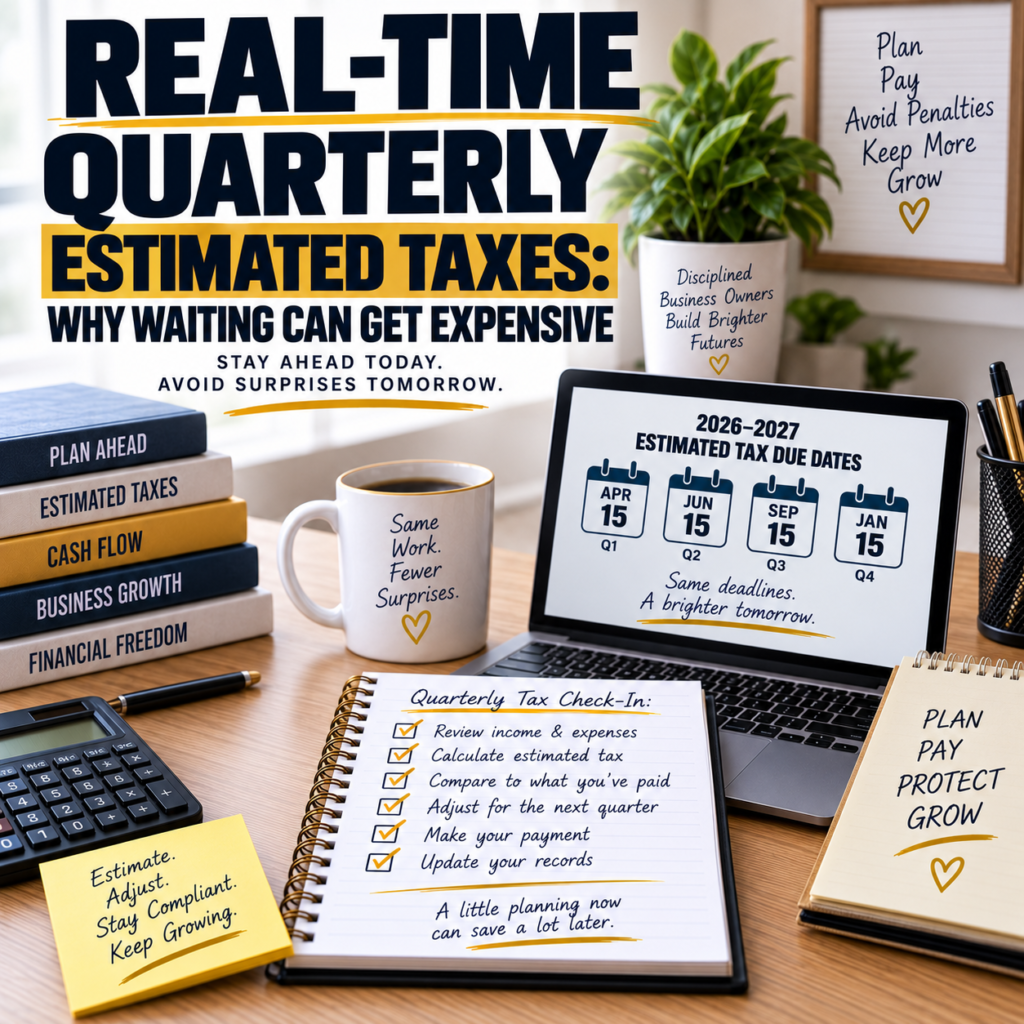
2026-2027 due dates: April 15, June 15, September 15, and January 15.
Not sure which number applies to your situation, or want it worked out for you? Run it through the Estimated Tax Safe Harbor Calculator; plug in last year’s tax and this year’s projected income, and it tells you exactly what to pay each quarter to stay protected.
Read Also: Estimated Taxes: What They Are and Why Missing Them Gets Expensive
When Income Doesn’t Cooperate
Freelancers, contractors, and small business owners rarely earn in four equal slices. A slow spring and a huge fourth quarter is normal. But the default assumption baked into estimated taxes is that you earned evenly all year, which can generate a penalty for Q1 and Q2 even when your annual total is fully paid.
Two tools solve this:
The annualized income installment method. Instead of dividing your projected tax by four, you calculate each installment based on what you actually earned in that period. It’s reported on Form 2210, Schedule AI. It takes more bookkeeping, but for seasonal or lumpy income it can eliminate a penalty.
W-2 withholding, if you or a spouse has a job. Withholding is treated as paid evenly throughout the year regardless of when it actually happened. So if you realize in November that you’re $6,000 short, increasing withholding on a paycheck in December can retroactively patch earlier quarters in a way a December estimated payment cannot.
A 30-Minute Quarterly Review
Real-time tracking sounds like a project. It isn’t. Once a quarter, before the due date:
- Pull year-to-date revenue and expenses from your bookkeeping software.
- Calculate net profit and multiply by your combined rate; a common working estimate is 25-30%, which covers 15.3% self-employment tax plus federal income tax. Add state if applicable.
- Subtract what you’ve already paid, including any spouse’s withholding.
- Divide the remainder by the quarters left and adjust your next payment.
- Pay it through IRS Direct Pay or EFTPS and log the confirmation number.
Four short sessions a year. That’s the whole system.
Read Also: Quarterly Tax Planning: How Estimate Tax Projections Make April Easier
Cash Flow Is the Real Win
Penalties get the attention, but the bigger benefit of adjusting in real time is that you stop being surprised. A separate tax savings account, with a fixed percentage of every client payment transferred the day it lands, turns tax season from a cash-flow emergency into a transfer you already made.
The business owners who handle this well aren’t the ones with the most sophisticated systems. They’re the ones who look at the number four times a year instead of once.
Pro Tip: Before your income actually grows, set your estimated payments to the 100%/110% prior-year safe harbor. It’s a known, fixed number you can budget for, it protects you from penalties no matter how good the year gets, and it takes the guesswork out of every quarter. Then set aside the extra you’ll owe in a separate savings account; you keep the penalty protection and the cash is waiting when you file. For a full walkthrough of the system, safe harbor math, quarterly review habits, and what to do when income spikes mid-year, check out the Estimated Tax Playbook.
Want to learn more?
Explore the Business Owner Hub
Visit the Business Owner Hub for a guided experience through BizTax Playbook’s free educational resources, calculators, planning strategies, and tools to help you navigate your business journey with confidence.
Join Our Network
Join Our Network to receive educational tips, workflow reminders, tax law updates, deadlines, calculators, and other resources designed to help you make more informed business and tax decisions throughout the year.